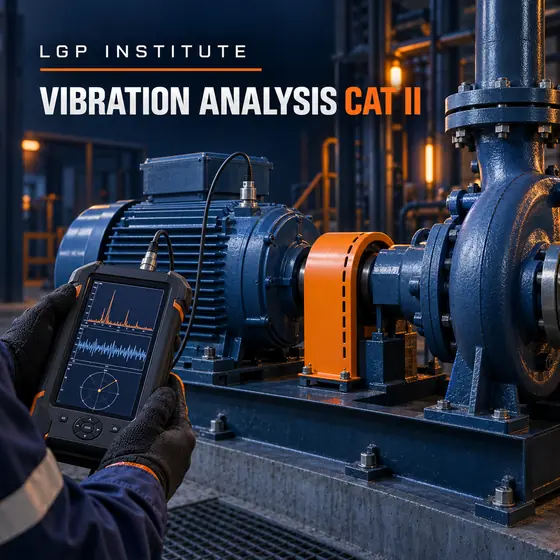
Vibration Analysis Cat II

Develop practical vibration analysis skills for collecting reliable data, configuring vibration analyzers, interpreting spectra, time waveforms and phase measurements, and diagnosing common faults in rotating machinery.

type course

In person

time course

180 minutes

lessons count

12 sessions

level

Basic

certificate

Educational certificate

course status

Enrolling

Description

The Vibration Analysis CAT II Course is designed for technicians, engineers and vibration analysts who want to advance beyond basic vibration monitoring and develop practical machinery diagnostic skills.

Participants learn how to select the correct measurement settings, verify data quality, identify fault frequencies and interpret vibration patterns caused by mechanical, electrical and operational problems.

The course provides practical knowledge applicable to electric motors, pumps, fans, compressors, gearboxes, bearings and other rotating machinery.

COURSE SYLLABUS

  1. Maintenance and Condition Monitoring

• Reactive, preventive, predictive and proactive maintenance
• The role of vibration analysis in machinery reliability
• Condition-monitoring technologies
• Machinery inspection routes and data collection programs

  1. Vibration Principles

• Amplitude, frequency and phase
• Displacement, velocity and acceleration
• Peak, peak-to-peak and RMS values
• Harmonics, sidebands and forcing frequencies
• Rotational and non-synchronous vibration

  1. Sensors and Data Collection

• Accelerometers, velocity sensors and displacement probes
• Sensor selection and frequency response
• Correct sensor mounting methods
• Horizontal, vertical and axial measurement points
• Measurement repeatability and data quality
• Identifying incorrect or misleading measurements

  1. Vibration Analyzer Configuration

• Frequency range and Fmax
• Lines of resolution
• Sampling and measurement duration
• Window selection and spectral leakage
• Spectral averaging
• Triggering and phase reference
• Routine routes and special measurements

  1. Signal Processing

• Relationship between the time waveform and spectrum
• Fast Fourier Transform fundamentals
• Filtering and signal conditioning
• Aliasing and anti-aliasing
• Dynamic range and noise floor
• Envelope analysis fundamentals

  1. Spectrum Analysis

• Systematic spectrum interpretation
• Running speed and harmonic identification
• Sideband pattern recognition
• Fault-frequency calculations
• Spectrum comparison and vibration trending

  1. Time Waveform Analysis

• Time waveform interpretation
• Impacts, modulation and repetitive events
• Crest factor and waveform shape
• Bearing and gearbox applications

  1. Phase Analysis

• Phase measurement principles
• Single-channel phase measurement
• Comparing phase between bearings
• Using phase to distinguish unbalance, misalignment and looseness

  1. Common Machinery Faults

• Static, couple and dynamic unbalance
• Angular and offset misalignment
• Mechanical looseness
• Bent shafts and eccentric components
• Soft foot
• Mechanical and electrical runout
• Rub and impacting conditions

  1. Rolling-Element Bearing Analysis

• Bearing construction and failure stages
• Bearing defect frequencies
• Inner race, outer race, rolling element and cage faults
• High-frequency measurements
• Envelope analysis
• Lubrication-related vibration patterns

  1. Gearbox Analysis

• Gear mesh frequency
• Gear harmonics and sidebands
• Gear wear and eccentricity
• Tooth damage
• Load-related vibration patterns

  1. Motors and Driven Equipment

• Mechanical and electrical motor faults
• Rotor and stator-related vibration
• Pump, fan and compressor vibration
• Cavitation and flow-related vibration
• Belt and pulley problems

  1. Natural Frequency and Resonance

• Natural frequency and resonance
• Mass, stiffness and damping
• Recognizing resonance in vibration data
• Run-up and coast-down testing
• Impact testing fundamentals

  1. Corrective Actions

• Precision shaft alignment fundamentals
• Field balancing fundamentals
• Correcting looseness and structural problems
• Reducing resonance
• Confirming machinery condition after repair

  1. Alarm Limits and Reporting

• Overall vibration alarm limits
• Spectral band alarms
• Baseline measurements and trending
• Evaluating vibration severity
• Diagnostic reporting
• Maintenance recommendations

WHO SHOULD ATTEND?

• Vibration analysts with basic experience
• Condition-monitoring technicians
• Mechanical and maintenance engineers
• Reliability professionals
• Predictive-maintenance personnel
• Rotating machinery service technicians

RECOMMENDED PREREQUISITE

Vibration Analysis CAT I training or equivalent practical knowledge of vibration measurement and basic spectrum analysis is recommended.

LEARNING OUTCOMES

After completing this course, participants should be able to:

• Configure vibration analyzers correctly
• Collect consistent and reliable vibration data
• Interpret spectra, time waveforms and phase measurements
• Diagnose common rotating machinery faults
• Evaluate bearings, gears, motors, pumps, fans and compressors
• Perform basic tests to confirm diagnostic conclusions
• Recommend appropriate corrective actions
• Prepare clear machinery condition reports

COURSE INFORMATION

Delivery Method: Online
Course Language: English
Course Fee: USD 170
Online Examination Fee: USD 100
Passing Score: 70%
Certificate: Issued by LGP Institute, Türkiye, upon successful completion of the examination.

For more information and registration, contact LGP Institute today.

Course meetings
Fundamentals of Vibration Analysis

We start by understanding the core concepts of vibration and condition monitoring in practice.

Introduction to Condition Monitoring رایگان

The principles of predictive maintenance and machine health.

Amplitude, Frequency, and Phase فایل صوتی

Understanding the basic parameters of a vibration signal.

خصوصی
این درس خصوصی است. برای مشاهده باید دوره را خریداری کنید.

Basic Units and Conversions کوئیز

Displacement, Velocity, and Acceleration measurements.

خصوصی
این درس خصوصی است. برای مشاهده باید دوره را خریداری کنید.
Understanding Rotating Machinery

We explore various types of industrial equipment and their mechanical components.

Electric Motors & Pumps مقاله

Identifying components and common vibration sources.

Content

Fans, Compressors, and Gearboxes ویدئو

Characteristics of complex rotating equipment.

خصوصی
این درس خصوصی است. برای مشاهده باید دوره را خریداری کنید.
Sensors and Data Acquisition

Learn how to select and mount sensors to gather accurate vibration data.

Types of Accelerometers آزمون

Choosing the right sensor for the specific frequency range.

Content

Sensor Mounting Techniques ویدئو

Magnets, stud mounts, and how mounting affects data quality.

این درس خصوصی است. برای مشاهده باید دوره را خریداری کنید.
Diagnosing Common Machinery Faults

Identifying unbalance, misalignment, and looseness in equipment.

Understanding Unbalance رایگان

Causes of mass unbalance and its specific vibration profile.

Shaft Misalignment Basics فایل صوتی

Angular and parallel misalignment signatures.

خصوصی
این درس خصوصی است. برای مشاهده باید دوره را خریداری کنید.

Mechanical Looseness رایگان

Structural and rotating looseness identification.

خصوصی
این درس خصوصی است. برای مشاهده باید دوره را خریداری کنید.
Introduction to Spectrum Analysis

Reading and interpreting frequency spectrums and time waveforms.

Reading a Vibration Spectrum رایگان

Understanding the FFT (Fast Fourier Transform) and frequency domain.

Recognizing Fault Frequencies فایل صوتی

Identifying harmonics, sub-harmonics, and sidebands.

خصوصی
این درس خصوصی است. برای مشاهده باید دوره را خریداری کنید.

Time Waveform Basics رایگان

When to use time domain analysis over spectrums.

خصوصی
این درس خصوصی است. برای مشاهده باید دوره را خریداری کنید.
Rolling Element Bearing Faults

Early detection of bearing degradation using high-frequency techniques.

Bearing Components and Frequencies رایگان

Calculating BPFI, BPFO, BSF, and FTF.

Stages of Bearing Failure فایل صوتی

Tracking degradation from Stage 1 to Stage 4.

خصوصی
این درس خصوصی است. برای مشاهده باید دوره را خریداری کنید.

High-Frequency Detection Methods رایگان

Using envelope analysis and shock pulse methods.

Safety and Reporting

Ensuring industrial safety during data collection and writing health reports.

Safe Data Collection Practices رایگان

Personal protective equipment and hazard awareness near rotating parts.

Defining Alarm Limits فایل صوتی

Setting ISO standard alerts and baseline thresholds.

خصوصی
این درس خصوصی است. برای مشاهده باید دوره را خریداری کنید.

Generating Maintenance Reports رایگان

Communicating machine health status clearly to the maintenance team.

Comments

Reviews

There are no reviews yet.

Be the first to review “Vibration Analysis Cat II”

Your email address will not be published. Required fields are marked *

Request for advice

Enter your mobile number, and our advisors will contact you within the next two working days during business hours (9 am to 6 pm) for a free investment consultation.