


Precision Shop Balancing
Master Precision Rotor Balancing in the Workshop
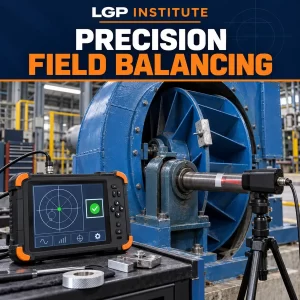
The LGP Institute Precision Shop Balancing Course is designed for technicians, engineers, and balancing specialists who perform rotor balancing using professional balancing machines in workshop environments.
This course provides a practical understanding of rotor unbalance, balancing methods, correction techniques, balancing tolerances, and the correct use of shop balancing equipment.
Participants will learn how to identify unbalance conditions, select the correct balancing method, determine correction planes, calculate correction weights, and verify final balance quality according to international practices.
What You Will Learn
By completing this course, participants will be able to:
Understand static, couple, and dynamic unbalance
Identify the causes and effects of rotor unbalance
Select single-plane or two-plane balancing
Prepare and mount rotors correctly on balancing machines
Select suitable balancing speed and correction planes
Use trial weights correctly
Calculate correction mass and angular position
Perform single-plane balancing
Perform two-plane dynamic balancing
Apply correction weights by adding or removing mass
Split and combine balancing weights
Understand residual unbalance
Calculate permissible residual unbalance
Apply balance quality grades
Understand ISO 21940 balancing requirements
Troubleshoot unstable or non-repeatable balancing results
Verify and document final balancing results
Course Content
Fundamentals of Balancing
What is rotor unbalance?
Centrifugal force and vibration
Causes of unbalance
Static, couple, and dynamic unbalance
Shop Balancing Machines
Horizontal balancing machines
Vertical balancing machines
Hard-bearing and soft-bearing machines
Measurement sensors and balancing systems
Rotor mounting and machine setup
Rotor Preparation
Rotor inspection
Cleaning and assembly
Shaft and mounting surface inspection
Correct setup before balancing
Single-Plane Balancing
Initial measurement
Trial weight selection
Correction calculation
Weight installation
Verification run
Two-Plane Balancing
Correction plane selection
Trial runs
Influence coefficients
Dynamic correction
Final verification
Weight Correction Techniques
Adding correction weights
Removing material
Drilling and grinding
Splitting weights
Combining weights
Correction at different radii
Balance Quality and Standards
Residual unbalance
Permissible residual unbalance
Balance quality grades
ISO 21940 principles
Final acceptance criteria
Troubleshooting
Unstable readings
Mechanical looseness
Rotor runout
Mounting errors
Incorrect trial weights
Repeatability problems
Poor balancing convergence
Who Should Attend?
This course is suitable for:
Balancing technicians
Workshop technicians
Maintenance engineers
Reliability engineers
Vibration analysts
Rotor repair specialists
Pump, fan, motor, and turbine repair workshops
Industrial service companies
Examination & Certification
Participants can take the LGP Institute Precision Shop Balancing Examination after completing the course.
Successful participants will receive the:
LGP Institute Precision Shop Balancing Certificate
This certificate confirms the participant’s knowledge of rotor balancing principles, workshop balancing procedures, correction methods, tolerances, and practical balancing techniques.
Training and Certification
The course is delivered through the LGP Institute online learning platform. Participants may register separately for the final online examination.
Candidates who successfully pass the examination with a score of 70% or higher will receive a Precision Shop Balancing Certificate issued by LGP Institute, Türkiye.
Course Information
- Course Fee: USD 130
- Online Examination: USD 90
- Delivery Method: Online and self-paced
- Language: English
- Certificate: LGP Institute, Türkiye
- Minimum Passing Score: 70%
Course meetings
Comments
Request for advice
Enter your mobile number, and our advisors will contact you within the next two working days during business hours (9 am to 6 pm) for a free investment consultation.




Reviews
There are no reviews yet.