|
|
In person |
|---|---|
|
|
180 minutes |
|
|
12 sessions |
|
|
Basic |
|
|
Educational certificate |
|
|
Enrolling |
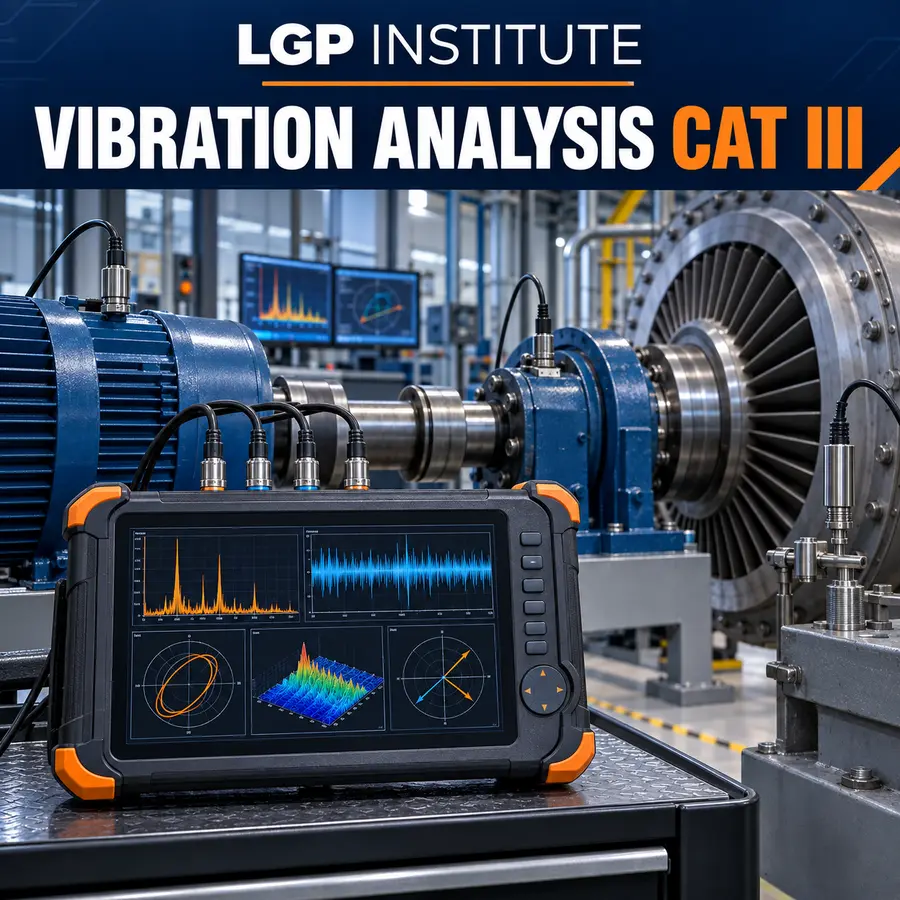
Vibration Analysis Category III
Advanced Vibration Analysis for Senior Analysts & Condition Monitoring Professionals
Take your vibration analysis skills to the next level with Vibration Analysis Category III at LGP Institute.
This advanced, practical course is designed for experienced vibration analysts who want to move beyond routine data collection and basic fault identification toward advanced machinery diagnostics, machine dynamics, complex fault analysis, and condition monitoring program management.
Through a combination of advanced theory, practical examples, industrial case studies, and diagnostic exercises, you will develop the skills required to investigate complex machinery problems and turn vibration data into reliable maintenance decisions.
What Will You Learn?
🔹 Advanced Vibration Analysis Fundamentals
Build a deeper understanding of vibration behavior and the principles that govern rotating machinery.
You will explore:
- Vibration signals and machine behavior
- Amplitude, frequency, and phase relationships
- Harmonics and sidebands
- Signal characteristics and fault signatures
- Vibration severity and trending
- Advanced measurement strategies
🔹 Advanced Signal Processing
Learn how signal processing affects the quality and interpretation of vibration data.
Topics include:
- Sampling and aliasing
- Frequency resolution
- Dynamic range
- Signal-to-noise ratio
- Windowing and leakage
- Averaging
- Filtering
- Frequency bands
- Order analysis
- Cross-channel measurements
- Coherence and correlation
You will learn not only how to analyze a spectrum, but also how to obtain the right data for a specific diagnostic problem.
🔹 Advanced Time Waveform Analysis
Time Waveform Analysis provides valuable information that may not be visible in a conventional spectrum.
You will learn how to use time waveform characteristics to investigate:
- Mechanical looseness
- Impacting
- Misalignment
- Bearing defects
- Gear faults
- Rubs
- Resonance
- Transient events
- Modulation and non-linear behavior
🔹 Phase Analysis
Phase is one of the most powerful tools for understanding machine behavior.
This course introduces practical phase analysis techniques used to investigate:
- Unbalance
- Misalignment
- Structural problems
- Resonance
- Mechanical looseness
- Shaft and machine movement
You will learn how to collect, interpret, and visualize phase information to understand how different parts of a machine are moving relative to one another.
🔹 Machine Dynamics & Resonance
Develop a deeper understanding of the dynamic behavior of rotating machinery and supporting structures.
Topics include:
- Natural frequencies
- Resonance
- Mass, stiffness, and damping
- Single Degree of Freedom systems
- Multiple Degree of Freedom systems
- Structural response
- Run-up and coast-down testing
- Bode plots
- Polar plots
- Impact testing
You will learn how to investigate resonance problems and determine whether structural dynamics are contributing to excessive vibration.
🔹 Operating Deflection Shape (ODS) Analysis
Move beyond individual measurement points and visualize how a machine or structure behaves during operation.
You will learn the fundamentals of Operating Deflection Shape Analysis, including:
- Phase-based machine movement
- ODS measurement concepts
- Visualization of machine motion
- Identification of abnormal structural movement
- Investigation of resonance-related problems
- Interpretation of ODS results
🔹 Introduction to Modal Analysis
Gain an introduction to the principles used to identify the dynamic characteristics of machines and structures.
Topics include:
- Natural frequencies
- Mode shapes
- Modal testing
- Frequency response
- Dynamic behavior
- Introduction to Finite Element Analysis (FEA)
This knowledge provides a foundation for understanding complex structural vibration problems.
🔹 Advanced Rolling Element Bearing Analysis
Develop advanced diagnostic skills for rolling element bearings.
You will learn how to identify and evaluate:
- Bearing characteristic frequencies
- Outer race defects
- Inner race defects
- Rolling element defects
- Cage-related faults
- High-frequency impacts
- Modulation
- Early-stage bearing damage
- Advanced bearing detection techniques
You will also explore the challenges associated with low-speed bearings and variable operating conditions.
🔹 Journal Bearing & Fluid Film Machinery
Understand the vibration behavior of machines equipped with fluid film bearings.
Topics include:
- Shaft displacement
- Orbit plots
- Centerline plots
- Eccentricity
- Oil whirl
- Oil whip
- Rotor instability
- Preload
- Dynamic behavior of fluid film bearings
These techniques are particularly valuable when analyzing large rotating machinery such as turbines, compressors, and other critical equipment.
🔹 Advanced Gearbox Diagnostics
Develop a systematic approach to diagnosing gearbox problems using vibration analysis.
You will investigate:
- Gear Mesh Frequency
- Gear harmonics
- Sidebands
- Gear wear
- Tooth damage
- Broken or damaged teeth
- Gear eccentricity
- Gear misalignment
- Backlash
- Loading effects
- Gear assembly behavior
The focus is on understanding how gearbox faults generate specific vibration patterns and how to distinguish between similar fault conditions.
🔹 Electric Motor Vibration Analysis
Learn how vibration analysis can be used to investigate mechanical and electrical problems in electric motors.
Topics include:
- Rotor-related problems
- Rotor eccentricity
- Stator-related problems
- Mechanical looseness
- Soft foot
- Broken rotor bars
- Electrical fault frequencies
- Motor current analysis fundamentals
🔹 Pumps, Fans & Compressors
Learn how operating conditions and process-related problems can affect vibration behavior.
You will examine problems such as:
- Cavitation
- Flow turbulence
- Recirculation
- Hydraulic instability
- Aerodynamic problems
- Mechanical problems
- Operating-condition-related vibration
The objective is to distinguish mechanical faults from process and aerodynamic/hydraulic problems.
From Diagnosis to Corrective Action
A successful vibration analyst should do more than identify a peak on a spectrum.
At LGP Institute, you will learn how to connect:
Measurement → Analysis → Diagnosis → Validation → Corrective Action
You will develop the ability to provide practical recommendations for issues such as:
- Dynamic balancing
- Shaft alignment
- Mechanical repairs
- Structural modifications
- Resonance problems
- Bearing replacement
- Gearbox maintenance
- Operating-condition changes
The ultimate goal is to help maintenance teams understand the root cause of a problem and take effective corrective action.
Condition Monitoring Program Management
At Category III level, vibration analysis becomes more than an individual diagnostic skill.
You will learn the principles required to develop and manage an effective Condition Monitoring Program, including:
- Program development
- Asset criticality
- Measurement strategies
- Baseline development
- Alarm setting
- Trend analysis
- Data quality management
- Reporting
- Diagnostic workflow
- Communication with maintenance and management
- Measuring program effectiveness
You will also develop the skills required to communicate technical findings clearly and support maintenance and reliability decisions.
Practical, Case-Based Learning
At LGP Institute, our approach focuses on connecting advanced theory with real-world machinery problems.
Throughout the course, you will work through practical scenarios designed to develop your ability to:
Observe → Measure → Analyze → Diagnose → Recommend
Instead of simply memorizing fault frequencies or diagnostic rules, you will learn to understand why a machine produces a particular vibration pattern and how to verify your diagnosis using multiple sources of information.
Who Is This Course For?
Vibration Analysis Category III is designed for experienced professionals working in:
- Vibration Analysis
- Condition Monitoring
- Predictive Maintenance
- Reliability Engineering
- Maintenance Engineering
- Rotating Equipment
- Machinery Diagnostics
It is particularly suitable for professionals who want to progress toward roles such as:
Senior Vibration Analyst
Condition Monitoring Specialist
Machinery Diagnostics Specialist
Reliability Engineer
Condition Monitoring Program Leader
What You Will Be Able to Do
By completing this course, you will be better prepared to:
✅ Analyze complex vibration signals
✅ Perform advanced spectrum and time waveform analysis
✅ Apply phase analysis to machinery diagnostics
✅ Investigate resonance and dynamic problems
✅ Understand ODS and modal analysis principles
✅ Diagnose advanced bearing and gearbox faults
✅ Analyze vibration behavior in pumps, fans, compressors, and motors
✅ Distinguish mechanical faults from process-related problems
✅ Recommend appropriate corrective actions
✅ Develop and manage condition monitoring strategies
✅ Communicate diagnostic findings effectively to maintenance and management teams
✅ Support more reliable and data-driven maintenance decisions
Take Your Vibration Analysis Career to the Next Level
Category III is where vibration analysis moves from routine monitoring to advanced machinery diagnostics.
At LGP Institute, you will develop the technical knowledge, analytical thinking, and practical diagnostic skills needed to investigate complex machinery problems and contribute at a higher level within reliability and condition monitoring teams.
Learn the Signal. Understand the Machine. Solve the Problem.
LGP Institute — Advanced Training in Vibration Analysis & Condition Monitoring
Course meetings
We start by understanding the core concepts of vibration and condition monitoring in practice.
Introduction to Condition Monitoring رایگان
The principles of predictive maintenance and machine health.
Amplitude, Frequency, and Phase فایل صوتی
Understanding the basic parameters of a vibration signal.
Basic Units and Conversions کوئیز
Displacement, Velocity, and Acceleration measurements.

We explore various types of industrial equipment and their mechanical components.
Electric Motors & Pumps مقاله
Identifying components and common vibration sources.
Content
Fans, Compressors, and Gearboxes ویدئو
Characteristics of complex rotating equipment.

Learn how to select and mount sensors to gather accurate vibration data.
Types of Accelerometers آزمون
Choosing the right sensor for the specific frequency range.
Content
Sensor Mounting Techniques ویدئو
Magnets, stud mounts, and how mounting affects data quality.

Identifying unbalance, misalignment, and looseness in equipment.
Understanding Unbalance رایگان
Causes of mass unbalance and its specific vibration profile.
Shaft Misalignment Basics فایل صوتی
Angular and parallel misalignment signatures.
Mechanical Looseness رایگان
Structural and rotating looseness identification.

Reading and interpreting frequency spectrums and time waveforms.
Reading a Vibration Spectrum رایگان
Understanding the FFT (Fast Fourier Transform) and frequency domain.
Recognizing Fault Frequencies فایل صوتی
Identifying harmonics, sub-harmonics, and sidebands.
Time Waveform Basics رایگان
When to use time domain analysis over spectrums.

Early detection of bearing degradation using high-frequency techniques.
Bearing Components and Frequencies رایگان
Calculating BPFI, BPFO, BSF, and FTF.
Stages of Bearing Failure فایل صوتی
Tracking degradation from Stage 1 to Stage 4.
High-Frequency Detection Methods رایگان
Using envelope analysis and shock pulse methods.

Ensuring industrial safety during data collection and writing health reports.
Safe Data Collection Practices رایگان
Personal protective equipment and hazard awareness near rotating parts.
Defining Alarm Limits فایل صوتی
Setting ISO standard alerts and baseline thresholds.
Generating Maintenance Reports رایگان
Communicating machine health status clearly to the maintenance team.
Comments
Request for advice
Enter your mobile number, and our advisors will contact you within the next two working days during business hours (9 am to 6 pm) for a free investment consultation.

Reviews
There are no reviews yet.