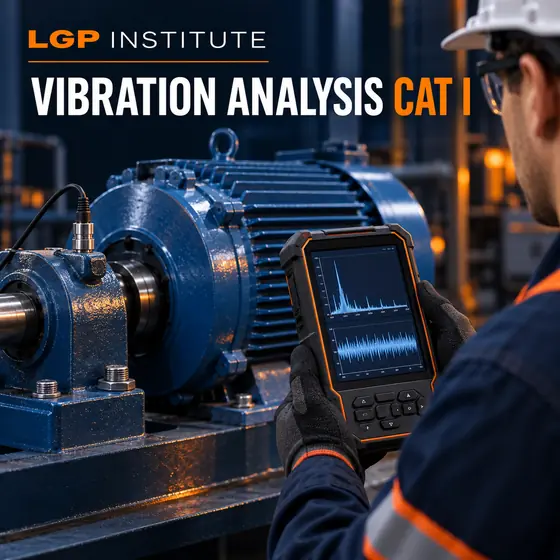
VibrationAanalysis Cat I

Build a strong foundation in vibration analysis and learn how to collect reliable vibration data, recognize basic vibration patterns and identify common faults in rotating machinery.

type course

In person

time course

180 minutes

lessons count

12 sessions

level

Basic

certificate

Educational certificate

course status

Enrolling

Description

The Vibration Analysis CAT I Course provides essential knowledge for technicians, engineers and maintenance professionals who are beginning their journey in machinery condition monitoring.

Participants learn the fundamentals of vibration, measurement units, sensor selection, measurement locations, basic analyzer settings and the interpretation of time waveforms and vibration spectra.

The course focuses on practical skills required to collect repeatable data and recognize common problems such as unbalance, misalignment, looseness, resonance and rolling-element bearing faults.

COURSE SYLLABUS

  1. Maintenance Strategies

• Reactive maintenance
• Preventive maintenance
• Predictive maintenance
• Proactive maintenance
• The role of condition monitoring in machinery reliability

  1. Introduction to Condition Monitoring

• Purpose and benefits of condition monitoring
• Vibration analysis applications
• Introduction to thermography, ultrasound and oil analysis
• Understanding machinery inspection routes
• Establishing baseline measurements

  1. Vibration Fundamentals

• What is vibration?
• Amplitude, frequency and phase
• Displacement, velocity and acceleration
• Peak, peak-to-peak and RMS values
• Frequency, period and rotational speed
• Introduction to harmonics

  1. Vibration Measurement Units

• Metric and imperial units
• Displacement measurement
• Velocity measurement
• Acceleration measurement
• Selecting the appropriate measurement parameter

  1. Vibration Sensors

• Accelerometers
• Velocity sensors
• Displacement probes
• Sensor sensitivity and frequency range
• Selecting the correct sensor
• Basic sensor inspection and care

  1. Sensor Mounting

• Magnetic mounting
• Stud mounting
• Adhesive mounting
• Handheld probe measurements
• Effects of mounting methods on data quality
• Recognizing poorly mounted sensors

  1. Measurement Locations

• Horizontal, vertical and axial directions
• Selecting suitable bearing locations
• Motor and pump measurement points
• Consistent measurement practices
• Measurement point identification and naming

  1. Data Collection

• Creating and following measurement routes
• Collecting repeatable vibration data
• Machine operating conditions
• Load and speed considerations
• Identifying incorrect or unreliable data
• Basic data quality checks

  1. Vibration Analyzer Settings

• Frequency range and Fmax
• Lines of resolution
• Measurement duration
• Spectral averaging
• Basic window selection
• Introduction to analyzer configuration

  1. Time Waveform Analysis

• Understanding the time waveform
• Repetitive and non-repetitive vibration
• Recognizing impacts and abnormal events
• Crest factor fundamentals
• Relationship between waveform shape and machinery condition

  1. Spectrum Analysis

• Introduction to the vibration spectrum
• Running speed frequency
• Harmonics and frequency peaks
• Basic spectrum interpretation
• Comparing current and previous measurements
• Recognizing changes in machinery condition

  1. Introduction to Phase

• Basic phase concepts
• Phase reference
• Relationship between phase and machinery motion
• Basic applications in fault identification

  1. Common Machinery Faults

• Unbalance
• Angular and offset misalignment
• Mechanical looseness
• Soft foot
• Bent shaft indications
• Resonance fundamentals
• Basic belt and pulley problems

  1. Rolling-Element Bearing Faults

• Bearing components
• Common bearing failure causes
• Early and advanced bearing damage
• Introduction to bearing defect frequencies
• Recognizing basic bearing fault patterns
• Lubrication-related problems

  1. Alarm Limits and Trending

• Overall vibration levels
• Warning and danger limits
• Baseline measurements
• Vibration trending
• Comparing similar machines
• Basic machinery condition assessment

  1. Reporting and Recommendations

• Recording measurement results
• Describing machinery condition clearly
• Preparing basic vibration reports
• Communicating findings to maintenance teams
• Recommending further inspection or corrective action

WHO SHOULD ATTEND?

• Maintenance technicians
• Mechanical technicians
• Condition-monitoring personnel
• Reliability professionals
• Plant engineers
• Machinery service technicians
• Individuals beginning a career in vibration analysis

PREREQUISITE

No previous vibration analysis certification is required. Basic knowledge of mechanical equipment and rotating machinery is helpful.

LEARNING OUTCOMES

After completing this course, participants should be able to:

• Explain the basic principles of machinery vibration
• Select suitable sensors and measurement locations
• Collect consistent and repeatable vibration data
• Configure basic vibration analyzer settings
• Understand time waveforms and vibration spectra
• Recognize common machinery fault patterns
• Identify potentially unreliable measurements
• Monitor vibration trends and machinery condition
• Prepare clear basic condition-monitoring reports

COURSE INFORMATION

Delivery Method: Online
Course Language: English
Course Fee: USD 120
Online Examination Fee: USD 80
Passing Score: 70%
Certificate: Issued by LGP Institute, Türkiye, upon successful completion of the examination.

For more information and registration, contact LGP Institute today.

Course meetings
Fundamentals of Vibration Analysis

We start by understanding the core concepts of vibration and condition monitoring in practice.

Introduction to Condition Monitoring رایگان

The principles of predictive maintenance and machine health.

Amplitude, Frequency, and Phase فایل صوتی

Understanding the basic parameters of a vibration signal.

خصوصی
این درس خصوصی است. برای مشاهده باید دوره را خریداری کنید.

Basic Units and Conversions کوئیز

Displacement, Velocity, and Acceleration measurements.

خصوصی
این درس خصوصی است. برای مشاهده باید دوره را خریداری کنید.
Understanding Rotating Machinery

We explore various types of industrial equipment and their mechanical components.

Electric Motors & Pumps مقاله

Identifying components and common vibration sources.

Content

Fans, Compressors, and Gearboxes ویدئو

Characteristics of complex rotating equipment.

خصوصی
این درس خصوصی است. برای مشاهده باید دوره را خریداری کنید.
Sensors and Data Acquisition

Learn how to select and mount sensors to gather accurate vibration data.

Types of Accelerometers آزمون

Choosing the right sensor for the specific frequency range.

Content

Sensor Mounting Techniques ویدئو

Magnets, stud mounts, and how mounting affects data quality.

این درس خصوصی است. برای مشاهده باید دوره را خریداری کنید.
Diagnosing Common Machinery Faults

Identifying unbalance, misalignment, and looseness in equipment.

Understanding Unbalance رایگان

Causes of mass unbalance and its specific vibration profile.

Shaft Misalignment Basics فایل صوتی

Angular and parallel misalignment signatures.

خصوصی
این درس خصوصی است. برای مشاهده باید دوره را خریداری کنید.

Mechanical Looseness رایگان

Structural and rotating looseness identification.

خصوصی
این درس خصوصی است. برای مشاهده باید دوره را خریداری کنید.
Introduction to Spectrum Analysis

Reading and interpreting frequency spectrums and time waveforms.

Reading a Vibration Spectrum رایگان

Understanding the FFT (Fast Fourier Transform) and frequency domain.

Recognizing Fault Frequencies فایل صوتی

Identifying harmonics, sub-harmonics, and sidebands.

خصوصی
این درس خصوصی است. برای مشاهده باید دوره را خریداری کنید.

Time Waveform Basics رایگان

When to use time domain analysis over spectrums.

خصوصی
این درس خصوصی است. برای مشاهده باید دوره را خریداری کنید.
Rolling Element Bearing Faults

Early detection of bearing degradation using high-frequency techniques.

Bearing Components and Frequencies رایگان

Calculating BPFI, BPFO, BSF, and FTF.

Stages of Bearing Failure فایل صوتی

Tracking degradation from Stage 1 to Stage 4.

خصوصی
این درس خصوصی است. برای مشاهده باید دوره را خریداری کنید.

High-Frequency Detection Methods رایگان

Using envelope analysis and shock pulse methods.

Safety and Reporting

Ensuring industrial safety during data collection and writing health reports.

Safe Data Collection Practices رایگان

Personal protective equipment and hazard awareness near rotating parts.

Defining Alarm Limits فایل صوتی

Setting ISO standard alerts and baseline thresholds.

خصوصی
این درس خصوصی است. برای مشاهده باید دوره را خریداری کنید.

Generating Maintenance Reports رایگان

Communicating machine health status clearly to the maintenance team.

Comments

1 review for VibrationAanalysis Cat I

  1. سعید –

    Thank you to Engineer Mousavi and the good LGP website for compiling this useful training course.

    • admin –

      Thank you for your valuable support, dear Saeed 🌹

Add a review

Your email address will not be published. Required fields are marked *

Request for advice

Enter your mobile number, and our advisors will contact you within the next two working days during business hours (9 am to 6 pm) for a free investment consultation.