|
|
In person |
|---|---|
|
|
240 |
|
|
12 sessions |
|
|
Basic |
|
|
Educational certificate |
|
|
Enrolling |
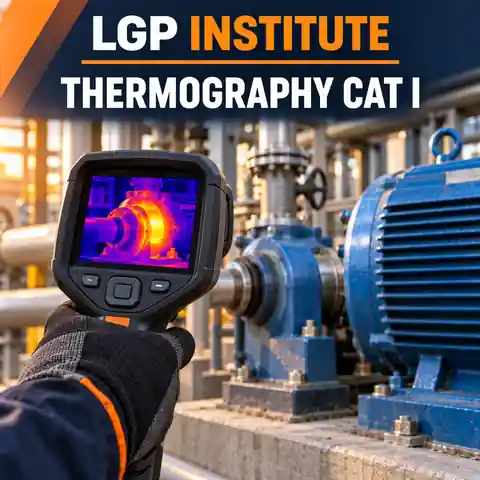
The Thermography CAT I Course introduces the principles and practical applications of infrared thermal imaging for maintenance and condition monitoring.
Participants learn how heat transfer, surface properties, camera settings and environmental conditions affect thermal images and temperature measurements. The course emphasizes collecting reliable inspection data and distinguishing genuine thermal anomalies from reflections and measurement errors.
Applications include electrical equipment, motors, bearings, mechanical systems, insulation and building envelopes.
COURSE SYLLABUS
- Introduction to Infrared Thermography
- The purpose of thermal inspections
- Infrared radiation and the electromagnetic spectrum
- How a thermal camera forms an image
- Qualitative and quantitative inspections
- Applications and limitations of thermography
- Heat and Temperature
- The difference between heat and temperature
- Temperature scales and temperature differences
- Conduction, convection and radiation
- Thermal conductivity and insulation
- Thermal capacity and transient heating
- Surface Properties and Infrared Radiation
- Emissivity, reflectivity and transmissivity
- Reflected apparent temperature
- Effects of surface finish, oxidation and coatings
- Challenges when inspecting shiny metals
- Distinguishing reflections from actual hot spots
- Thermal Camera Operation
- Camera components and basic controls
- Focus and lens selection
- Temperature measurement ranges
- Manual and automatic level and span
- Colour palettes and image contrast
- Saving thermal images and corresponding visible photographs
- Measurement Accuracy
- Emissivity and reflected temperature settings
- Distance and atmospheric effects
- Field of view and spatial resolution
- Target size and measurement spot size
- Viewing angle and focus
- Common causes of incorrect temperature readings
- Inspection Planning and Data Collection
- Defining the inspection scope
- Equipment identification and inspection routes
- Recording operating load and ambient conditions
- Selecting suitable inspection times
- Maintaining consistent viewing positions
- Capturing repeatable images for comparison
- Thermal Image Interpretation
- Recognizing normal and abnormal thermal patterns
- Comparing similar components under similar conditions
- Evaluating temperature differences
- Understanding the influence of load and cooling
- Recognizing misleading patterns
- Identifying findings that require further investigation
- Electrical Applications
- Thermal patterns in connections, terminals and contacts
- Comparative inspection of phases and similar components
- Heating associated with resistance and loading
- Switchgear, distribution panels and cable connections
- Inspection limitations and electrical safety awareness
- Mechanical Applications
- Thermal inspection of motors and bearing housings
- Friction-related heating
- Belts, pulleys and couplings
- Pumps and other rotating equipment
- Combining thermal findings with other condition-monitoring data
- Insulation and Building Applications
- Insulation defects and thermal bridges
- Heat-loss patterns
- Air-leakage indications under suitable conditions
- Moisture-related thermal patterns and the need for confirmation
- Effects of sunlight, wind and weather
- Inspection Safety and Limitations
- Site access and inspection procedures
- Working near rotating and hot equipment
- Electrical inspection boundaries and authorization
- Avoiding unsafe access for a better image
- Recognizing the limits of thermal evidence
- Reporting and Follow-Up
- Organizing thermal and visible images
- Recording camera settings and operating conditions
- Describing findings clearly
- Documenting limitations and uncertainty
- Recommending further inspection
- Comparing results after corrective work
WHO SHOULD ATTEND?
- Maintenance technicians
- Electrical and mechanical engineers
- Condition-monitoring personnel
- Reliability professionals
- Facility and building inspectors
- New thermal camera users
RECOMMENDED BACKGROUND
No previous thermography training is required. Basic knowledge of the equipment being inspected is helpful.
LEARNING OUTCOMES
After completing this course, participants should be able to:
- Explain basic heat transfer and infrared principles
- Operate a thermal camera using appropriate settings
- Capture focused and repeatable thermal images
- Recognize the effects of emissivity and reflections
- Identify common thermal anomalies
- Understand when additional testing is necessary
- Prepare clear inspection reports
COURSE INFORMATION
Provider: LGP INSTITUTE
Delivery Method: Online
Language: English
Course Fee: USD 100
Separate Online Examination Fee: USD 70
Candidates who successfully complete the examination receive a certificate issued by LGP Institute, Türkiye.
For more information and registration, contact LGP INSTITUTE today.
Course meetings
Getting familiar with thermography, its role in maintenance, and how the technology developed
Introduction and Overview ویدئو
Course objectives and what will be covered throughout the program
What Is Thermography ویدئو
Definition of thermography and its application in equipment inspection and condition monitoring
History of Thermography ویدئو
The origin and evolution of thermography and thermal imaging technology
Core concepts of temperature and the heat transfer mechanisms that underpin thermal analysis.
Temperature Measurement ویدئو
Temperature scales, measurement methods, and the difference between contact and non-contact approaches
Thermostatics and Heat Transfer ویدئو
Principles of thermostatics along with conduction and convection in industrial equipment
Radiation as the key mechanism behind thermography and where infrared sits in the spectrum
Heat Transfer by Radiation ویدئو
How thermal energy travels by radiation and why it matters for thermal imaging
The Electromagnetic Spectrum ویدئو
Structure of the electromagnetic spectrum and the infrared range used in thermography

The blackbody reference model, the governing radiation laws, and how a thermal image is formed
Blackbody and the Three Fundamental Laws of Radiation ویدئو
The blackbody concept and the three core laws describing the relationship between temperature and radiated energy
The Infrared Image ویدئو
How an infrared image is formed and radiated energy is converted into thermal data

How real surfaces behave compared with a blackbody, and the factors that affect measurement accuracy
Main Properties of a Radiating Body ویدئو
Radiative characteristics of real surfaces and how they differ from the ideal blackbody model
Emissivity and Its Importance ویدئو
The emissivity coefficient, its effect on measured temperature, and how to set it correctly
Effect of the Intervening Atmosphere in Thermography ویدئو
How distance, air, and ambient conditions attenuate the signal and introduce measurement error
Comments
Request for advice
Enter your mobile number, and our advisors will contact you within the next two working days during business hours (9 am to 6 pm) for a free investment consultation.

Reviews
There are no reviews yet.